
Self-Managing vs. Hiring a Property Manager: What Every Short-Term Rental Owner Needs to Know
You’ve got a property. Maybe it’s a cabin in the Smokies, a beach house on the South Carolina coast, or an investment you’ve been sitting on and finally ready to list. The question almost every owner asks at some point is the same: should I manage this myself, or hire a short-term rental property manager?
It’s one of the most important decisions you’ll make as a property owner — and there’s no universal right answer. The best choice depends on your time, your goals, your experience, and how you want to be involved in the business.
What we can tell you is this: both paths are legitimate, and both can work extremely well. Self-managing a short-term rental is a real, learnable system — and with the right tools in place, it’s more accessible than most owners realize. Hiring a professional property manager is an equally valid choice for owners who want to step back from day-to-day operations entirely. The key is understanding what each option demands — and what each one delivers.
Here’s an honest, side-by-side breakdown.
The Case for Self-Managing Your Short-Term Rental
Self-managing means you’re running the operation: listings, pricing, guest communication, cleaning coordination, maintenance, and reviews. For the right owner with the right setup, it’s a genuinely rewarding and profitable path.
✅ The Pros of Self-Management
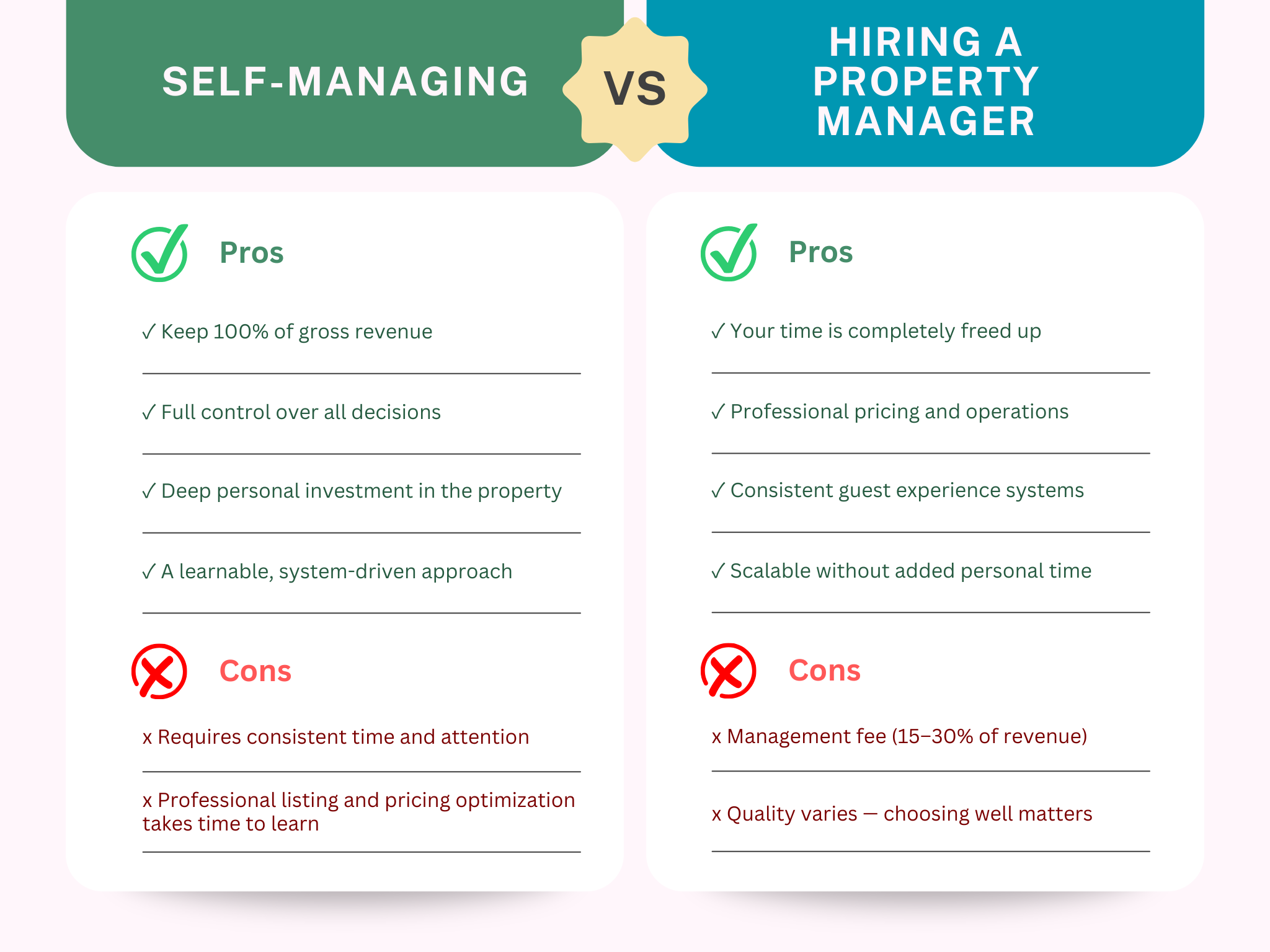
You keep 100% of your gross revenue. No management fee means your income stays yours. For many owners, that margin is meaningful — especially as the property matures and bookings grow.
You’re in complete control. Every decision — pricing, house rules, guest selection, upgrades — is yours to make. Owners who enjoy the business side often find this deeply satisfying.
Nobody knows your property like you do. That personal investment shows up in the details. Self-managing owners often create genuinely distinctive guest experiences that reflect real care for the space.
It’s a learnable system. Self-managing isn’t guesswork — it’s a set of repeatable processes. Licensing, vendor relationships, listing optimization, pricing strategy, guest communication — each piece can be built, automated, and refined over time.
❌ The Cons of Self-Management
It requires consistent time and attention. Guest inquiries, maintenance coordination, and cleaning logistics all need to be managed — especially in the early months while your systems are still being built.
Pricing strategy has a learning curve. Dynamic pricing tools have made this much more accessible, but understanding seasonal trends, demand cycles, and competitive positioning in your market takes time to dial in.
You’re the point of contact. Smart locks, automated messaging, and guest communication tools handle a lot automatically — but when something unexpected comes up, you’re the one responding.
Self-managing works best when you have the right systems and tools in place — and many owners do it very well.
It’s also worth noting that the technology available to self-managing owners today has changed the game significantly. The right tools can automate the most time-consuming parts of the job — pricing, guest communication, cleaning coordination, and more — and a well-built system can run largely in the background once it’s set up. The time burden of self-managing looks very different with the right stack in place versus without it.
The Case for Hiring a
Short-Term Rental Property Manager
A professional short-term rental property manager handles the full operation of your listing — from pricing and guest communication to cleaning standards, maintenance coordination, and review management. The best ones don’t just manage your property. They optimize it.
✅ The Pros of Hiring a Property Manager
Your time stays yours. No guest messages, no coordinating same-day turnovers, no unexpected calls. You own the asset without running the business.
Professional pricing and operations. Experienced managers use dynamic pricing tools and real market data to keep your rates competitive — and have established systems for cleaning, quality checks, and guest communication that are already built and tested.
Consistent guest experiences at scale. The best property managers have trained teams, cleaning checklists, and quality inspections that produce predictable, review-worthy stays for every guest.
Scalable without adding personal time. Adding a second or third property becomes a financial decision, not a time burden. A good management partner grows with your portfolio.
❌ The Cons of Hiring a Property Manager
Management fees reduce gross income. Most managers charge between 15–30% of revenue depending on services and market. That cost needs to be weighed against the time savings and any performance lift they deliver.
You give up some control. Pricing, guest acceptance, and day-to-day decisions move to someone else. This works best when you find a partner you genuinely trust.
Quality varies widely. The right manager can be transformative — the wrong one can underperform a motivated self-managing owner. Choosing well matters more than choosing fast.
The right property manager adds time back to your life — and a good one will more than justify their fee through better performance.
Quick Comparison:
Self-Managing vs. Hiring a Property Manager
Here’s how the two approaches stack up across the factors that matter most to property owners:
So — Which One Is Right for You?
Here’s a simple framework for thinking it through:
Self-managing may be the right fit if…
You want to maximize your net income and keep the management fee in your pocket
You enjoy the business side — systems, optimization, guest relationships
You have existing vendor relationships for cleaning and maintenance, or are ready to build them
You want to learn the business firsthand and build your own playbook

Hiring a property manager makes sense if…
You want to own the asset without being involved in daily operations
You’re in a competitive market and want professional positioning from day one
You’re looking to grow your portfolio without adding personal workload
The honest answer is that both paths can work — and for the right owner with the right setup, self-managing a property in a competitive market like the Smoky Mountains or the South Carolina coast is absolutely achievable. The key is knowing what tools and systems to lean on, and being realistic about the time you’re willing to invest.
The management fee is a real cost to weigh — and for many owners, the time savings and performance lift make it worthwhile. For others, building that expertise themselves is the right move. Neither answer is wrong.
Ready to Take the Next Step?
At EasyRes Hosting, we work with property owners across the Smoky Mountains and South Carolina coast — whether they’re looking for full-service property management or want to learn how to run their own listing the right way.
If you’re exploring professional management, we’d love to talk through what that could look like for your property.
If you’re committed to self-managing and want a proven system to follow, we’ve built a course that walks you through everything — from licensing and vendor sourcing to listing optimization, automation, and launch strategy.
Either way, we’re here to help you get the most out of your investment.
📩 Reach out at support@easyreshosting.com
Or connect with Sean & Vanessa using the button below ⬇️
